Short Answer
Tube and clamp (tube and coupler) scaffolds use vertical posts, ledgers, braces and couplers to build custom configurations for irregular plant geometry. Fastening toeboards on vertical tube is the typical challenge: tie wire, nails and blocking are slow and leave inconsistent gaps. A secure fastening method must meet the 50 lb force and 1/4 inch clearance requirements on round tube.
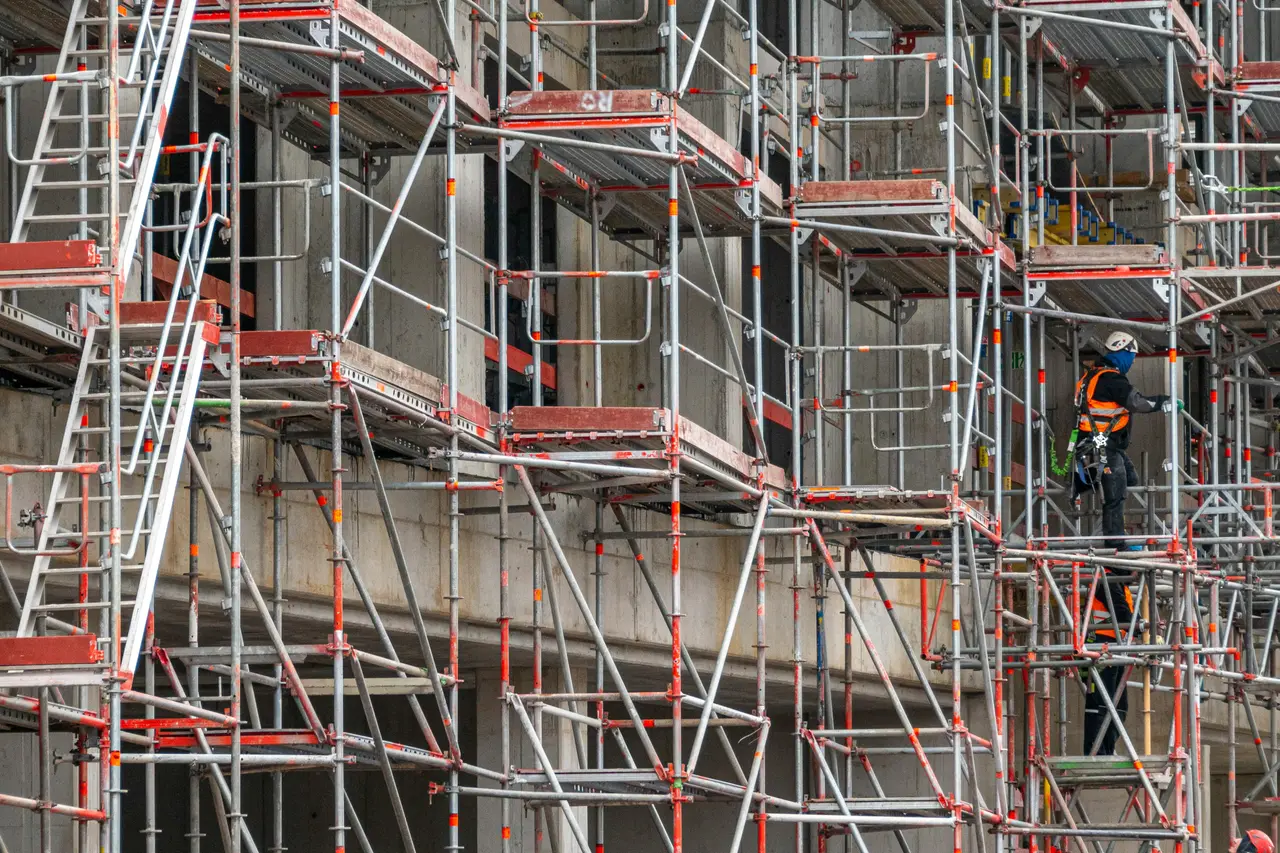
Tube and clamp scaffolds are the standard for industrial construction, turnarounds and maintenance work on refineries, power plants, chemical complexes, shipyards and process facilities. Unlike frame scaffolds, which bolt together in fixed configurations, tube and clamp systems let you adapt post locations, ledger lengths and brace angles to fit the irregular geometry of existing plant equipment. But that flexibility comes with a cost when it is time to fasten toeboards.
How Tube and Clamp Scaffolds Are Built
A tube and clamp system (also called tube and coupler, or loose couplers) uses vertical steel tube posts anchored to the working surface or mud sills. Horizontal ledgers run perpendicular to the posts and are clamped to them with removable couplers. Diagonal braces are clamped at top and bottom to create lateral stability. The coupler is a metal band or clamp that wraps partway around the tube (usually C-shaped), tightened by a bolt or screw. Because the couplers are removable and the tube is straight, you can adapt the scaffold to fit curves, offsets, elevation changes and spatial obstacles that would require frame cuts or field welding.
The advantage is speed and adaptability. The challenge is that each connection is hand-tightened, meaning quality depends on the crew. The bigger challenge for finishing the scaffold is fastening toeboards.
The Toeboard Problem on Tube and Clamp
When the decking is in place and the scaffold is ready for workers, toeboards must go up. Where tools or materials could fall and strike people below, 29 CFR 1926.451(h)(2) lists the protection options, and a toeboard along the platform edge is the most common. Where toeboards are used, the standard is unambiguous: toeboards must be at least 3.5 inches high, no more than 1/4 inch above the platform, able to take 50 pounds of force in any downward or horizontal direction, with openings no larger than 1 inch, and securely fastened at the outermost edge.
Today’s fastening methods on tube and clamp are the same ones used for decades:
- Number 9 tie wire: spiral wrapped or laced around the vertical tube and board. Slow. Creates sharp wire ends that curl up. Leaves inconsistent gaps because the wire stretches and relaxes over time.
- Nails: driven into wood ledgers where the toeboard sits. Requires ledger lumber to be positioned exactly, and pulls loose if the lumber shifts. Wire or blocking falls out or gets moved.
- Wood blocking: stacked between the platform deck and the bottom of the toeboard, with the toeboard nailed or wired on top. Adds unwanted height, falls off when crews remove it for equipment, and often moves before someone notices.
Each method can meet the standard when done right. In practice, crews skip the toeboard fastening step, use a wrong fastening method, or do the work so slowly that it becomes a budget liability. That is the problem the product is designed to solve: a bracket that clamps to the vertical tube and holds the board securely in an adjustable pocket, no wire, no nails, no guessing.
How Clamping Works on Vertical Tube
A clamp that grips the tube’s vertical post provides force transmission that does not depend on the ledger position or the board thickness. The coupler or clamp tightens around the tube, creating normal force. The bracket’s pockets hold the toeboard, and a set screw or lever tensioner locks it in place. Because the clamp attachment is independent of the platform structure, the fastening works reliably across different deck heights, ledger configurations and board materials.
The advantage is predictability. A clamp fastened to the vertical tube puts the load into the post rather than into wire or nails, and load testing is how you confirm it holds 50 lb. It also adapts to corners and angles: a pivot assembly lets the bracket arms rotate from a straight run (arms end-to-end along the ledger) to a 90 degree corner (arms at right angles) or any angle in between, without removing the coupler or moving the vertical post. On a plant with complex geometry, that matters because you do not have to unbuild and rebuild the scaffold at each direction change.
Meeting the OSHA Numbers
Tube and clamp uses loose couplers that can be placed anywhere along the tube. Ringlock, cuplock and kwikstage are different: they are system scaffolds with connection points fixed on the standards, and frame scaffold is its own type again (see toeboard options for system scaffolds). The vertical tube diameter is usually 48 millimeters (roughly 1.9 inches) on industrial scaffolds; older systems may use 2 inch tube or 1.75 inch.
The OSHA standard requires the complete assembly (tube, coupler, bracket, board and fastening) to withstand the loads. That is where fastening method matters: 1926.451(a)(1) says every scaffold and scaffold component shall be capable of supporting, without failure, its own weight and at least 4 times the maximum intended load applied or transmitted to it. The toeboard-specific requirement is in (h)(4)(i): at least 50 pounds applied downward or horizontally at any point, without failure. Ask any hardware supplier how their rating was established and against which requirement.
Clamping hardware that is designed and properly sized for that load transfers force through the coupler to the vertical tube, which is designed to take vertical and lateral loads throughout the scaffold. Tie wire alone does not provide that kind of predictable load path, and it loosens as it stretches and relaxes.
When You Are Planning Your Toeboard Installation
Start with the standard. Where toeboards are your falling object protection, they must be 3.5 inches minimum height, 1/4 inch maximum clearance, able to withstand 50 pounds of force in any downward or horizontal direction, with no openings larger than 1 inch, and securely fastened at the outermost edge.
Then check your scaffold system. If your design calls for tube and clamp, know whether your couplers and ledgers will work with your planned toeboard fastening method. 29 CFR 1926.451(b)(10) says components from different manufacturers shall not be intermixed unless they fit together without force and the scaffold’s structural integrity is maintained. That applies to any toeboard hardware you add: fit and compatibility are your responsibility to verify on your specific system, before the toeboard goes into service.
Finally, document your method. A competent person should inspect the toeboard assembly before work starts, and your records should show that the fastening method was checked and the load requirement was met. If you are using clamping hardware, keep the manufacturer’s specification sheet and your fit verification with the project documentation.
Diamond Deck on Tube and Clamp Scaffold
Diamond Deck is a steel bracket, made by Diamond Scaffold Services, that clamps to the vertical scaffold tube at deck level and holds two toeboards in adjustable pockets, with a set screw locking each board in place. A pivot lock sets the arms straight for a run, square for a corner, or at any angle in between, without modifying the tube or the scaffold. It is designed to the toeboard requirements of 29 CFR 1926.451(h)(4); load testing is in progress, and Professional Engineer review is in progress. U.S. patent pending.
The bracket is sized for standard 2x4 lumber or metal toeboards. Fit testing on major tube scaffold systems is in progress, so check with Diamond Scaffold Services on fit for your system. As with any scaffold hardware added to an existing system, users must confirm fit and compatibility on their own system, and a competent person must approve the installation before work begins.
Get Specifications for Your Project
Toeboard fastening is one of the easiest scaffolding items to skip until an inspector shows up. If you are planning a turnaround, new facility or standing scaffold program, start with the numbers: 3.5 inch minimum height, 1/4 inch maximum clearance, 50 pound force, 1 inch maximum openings, and secure fastening at the outermost edge. Then verify that your fastening method will work on your tube and clamp system before work starts.
Request a quote to get current Diamond Deck specifications, load test status, and lead times for your project.
Frequently Asked Questions
What Is Tube and Clamp Scaffold?
Tube and clamp (also called tube and coupler) is a scaffolding system built by hand from vertical steel tube posts, horizontal ledgers, cross-braces and removable couplers that grip the tube. It fits irregular plant geometry where frame and system scaffolds do not. Ringlock, cuplock and kwikstage are system scaffolds, not tube and clamp.
What Are the Main Toeboard Fastening Methods?
The incumbent methods are number 9 tie wire (spiral wrapped or laced), nails driven into wood ledgers, wood blocking between the toe board and the platform, or a combination. Each has drawbacks: wire is slow and leaves sharp ends, nails may miss ledgers if they are not positioned right, blocking adds height and falls off, and all three leave variable gaps above the platform.
How Do I Meet OSHA's 50 lb Force Requirement on Round Tube?
Under 29 CFR 1926.451(h)(4)(i), toeboards must withstand 50 lb in any downward or horizontal direction. Clamping hardware that grips the vertical tube provides more reliable force distribution than nails or wire alone. Any fastening method must be tested or verified to withstand that load at the worst-case point: the toe of the board, at the edge.
Why Do Irregular Geometry Plants Use Tube and Clamp?
Frame scaffolds come in fixed sizes; tube and clamp lets you adapt each post location, ledger span and brace pattern to fit your equipment layout, pipe racks, vessel shells and structural steel. The coupler connections adjust to small misalignments without cutting or forcing tube.
What Should I Check When Fastening Toeboards?
Secure fastening means tight at the outermost edge of the platform. Before work starts, check height (at least 3.5 in), clearance above the platform (no more than 1/4 in), openings (1 in maximum), force (50 lb at any point without failure), and that the fastening method will not slip or back out over the job.