Short Answer
OSHA toeboard rules apply on curves and odd angles exactly as on straight runs. Tie wire and wood blocking struggle to follow changing angles, which leaves gaps and loose joints. An adjustable-angle bracket holds each board at its own angle, but the installed toeboard must still meet the height, clearance, and 50 pound force limits of 29 CFR 1926.451(h)(4).
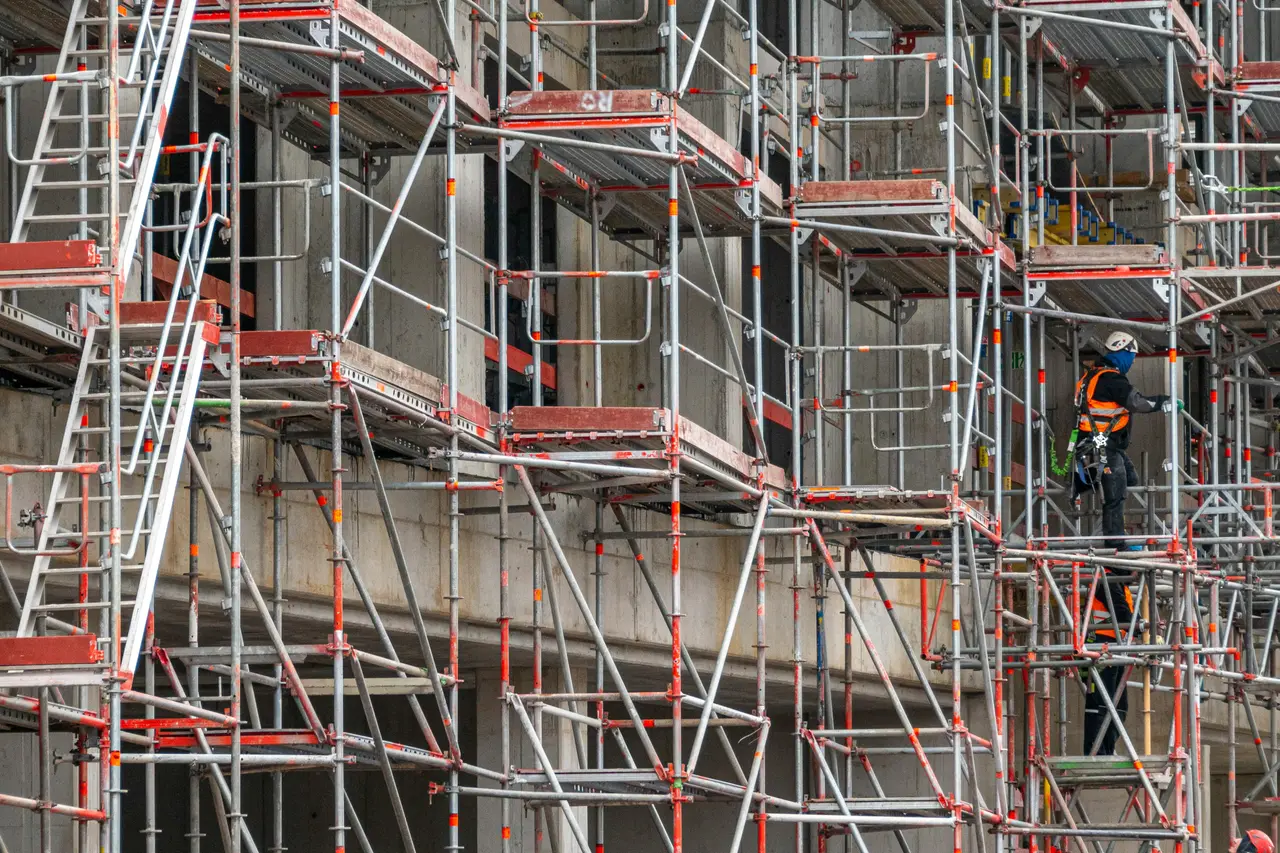
When a scaffolding crew works around a petrochemical tank, water vessel, column, or ship hull, the first challenge is geometry. Straight and flat does not describe most industrial surfaces. A platform that spirals or polygons around a curved perimeter has a toeboard problem: the board resists staying perpendicular to the platform edge, and tie wire or blocking alone cannot enforce it at every angle.
Why Curved and Angled Scaffolds Break Standard Toeboard Methods
Industrial vessels are cylindrical (tanks, stacks), conical (vessel ends, transitions), or compound. Each requires the scaffold to spiral around the perimeter, so the platform edge is constantly changing direction. A tangent line to a cylinder drawn at the platform edge points north; twenty feet away it points northeast. On a cone, the angle shifts continuously. Rectangular scaffolds have a milder version of the same problem, covered in why scaffold toeboards fail at corners.
Toeboards run along the perimeter edge, fighting every degree of turn. With traditional tie wire and wood blocking, a crew wraps wire through a 2x4 toeboard and over the vertical tube. The wire holds the board upward but cannot prevent it from rotating as the platform curves. On straight runs, gravity works. On curves, the board rotates inward, opening a gap larger than the 1/4 inch maximum allowed by 29 CFR 1926.451(h)(4)(ii). The competent person’s before-shift inspection should catch it, and the gap has to be fixed before work continues.
Wooden blocking faces the same issue: it holds one side but does not stop rotation. Nailing works but makes the scaffold unsalvageable (contractors reuse their fleets for decades). Cutting or angle-grinding a board to fit a permanent installation is not an option on a six-month turnaround that will be rented again.
How Adjustable Brackets Solve the Angle Problem
An adjustable-angle bracket locks the board at any angle, without cutting, nailing, or blocking. The bracket clamps to the vertical tube, and its arms pivot from straight to 90 degrees or any angle between. A pivot lock holds the angle once set. The board sits in a pocket in the arm (sized for a 2x4), and a set screw locks it in place. The installed assembly still has to meet the 50 pound force requirement in any downward or horizontal direction.
On a large tank, the tangent-line angle changes every 10 feet. Each bracket is set to match its platform’s angle and locked. The bracket adapts to the geometry instead of forcing materials to adapt. Diamond Deck is built to cut toeboard install time; savings are estimates while independent testing is completed. To size it for your job, use the savings calculator on the home page with your own numbers.
Installation on Tank Scaffolds: The Checklist
Before toeboards go in around a vessel:
-
Confirm the requirement with the competent person. Under 29 CFR 1926.451(h)(2), where tools or materials could fall and strike employees below, the employer must provide falling object protection: barricading, toeboards, screening, a guardrail system with small openings, or a canopy, debris net, or catch platform. The competent person decides where toeboards are the chosen method.
-
Confirm bracket compatibility. 29 CFR 1926.451(b)(10) requires different manufacturers’ components to fit without force and maintain structural integrity. Confirm the bracket fits your tube diameter (1.5, 1.9, or 2 inch are common) and your scaffold system. Diamond Deck fit testing on scaffold systems is in progress, so check with Diamond Scaffold Services for your system.
-
Set the bracket angle. Rotate the arms perpendicular to the platform edge at that point. A tangent line along the platform edge is your reference.
-
Seat and lock the boards. Fully seat the boards in the pockets and tighten the set screws. A board on the lip of the pocket will gap and loosen.
-
Verify height and clearance. The board must be at least 3-1/2 inches high, no more than 1/4 inch above the walking surface. Measure perpendicular to the platform (not vertically on angled brackets).
-
Test for movement. A secure board should not rattle or shift when walked on. Tighten set screws or re-seat the board if it moves.
-
Document the installation. A competent person’s log protects the contractor if an inspector or customer audit requests it.
The Same Rules Apply at Every Angle
Whether straight or angled, OSHA’s requirements stay the same: 3-1/2 inches high (measured perpendicular to the platform), no more than 1/4 inch clearance above the surface, 50 pounds of force in any downward or horizontal direction, no openings larger than 1 inch, and secure fastening at the outermost edge.
The job geometry decides the method. On straight runs, tie wire or blocking works. On curves and transitions, an adjustable-angle bracket is designed to hold the board perpendicular without cutting or nailing, preserving the scaffold for reuse.
Diamond Deck is a steel bracket designed to the toeboard requirements of 29 CFR 1926.451(h)(4). Load testing in progress. Professional Engineer review in progress. Fit testing on major tube scaffold systems is in progress; check with Diamond Scaffold Services for your system. U.S. patent pending. As with any scaffold hardware, users must confirm fit and compatibility with their own system under 1926.451(b)(10), and a competent person remains responsible for final inspection.
For tank turnarounds and curved scaffolds, start with the OSHA numbers: 3-1/2 inch height, 1/4 inch clearance, 50 pound force, 1 inch openings, and secure fastening. Confirm your method delivers those numbers on every angle without rework. Request a quote to discuss fit, compatibility, and lead time.
Frequently Asked Questions
Why Are Toeboards Harder Around Tanks and Vessels?
Cylindrical and conical shapes force scaffolding into a spiral or polygonal arrangement. Each rise in elevation, each corner, and each transition point has a different angle. Tie wire and nails can be forced to work on one side; an adjustable bracket can be set to each angle instead of forcing the board to fit.
What Does OSHA Require at a Curved Scaffold?
29 CFR 1926.451(h)(4) sets the same numbers everywhere: at least 3-1/2 inches high, no more than 1/4 inch clearance above the platform, capable of withstanding 50 pounds of force in any downward or horizontal direction, and openings no larger than 1 inch. An angled toeboard still must meet these requirements.
How Do You Set Toeboards on Angled or Curved Platforms?
The platform edge itself is angled; the toeboard must be perpendicular to the platform surface to keep workers from stepping over it. If the platform slopes or spirals, the toeboard direction changes with it, meaning the bracket holding it must rotate and lock at each new angle.
Do Angled Toeboards Need Different Fastening?
No. The fastening requirement under 1926.451(h)(4)(ii) is 'securely fastened in place at the outermost edge of the platform.' Whether straight or angled, the installed board must stay securely fastened and withstand the 50 pound force requirement. A bracket that clamps the vertical tube and locks the board in a pocket is one way to fasten it; the competent person still checks the installed assembly.
What Happens If a Toeboard Has a Small Gap at an Angle?
Clearance above the walking surface over 1/4 inch, or an opening over 1 inch, fails 29 CFR 1926.451(h)(4)(ii). Gaps happen most often at bends or corners when a single straight board is forced to span two sections of different angles. The competent person should flag it at the before-shift inspection so it is fixed before work.